Showing posts with label joint pain. Show all posts

Wednesday, November 4, 2009

Shin Splints? 10 Tips for Staying Pain-Free

I ran across a great article on active.com by Marlene Cimons and had to share some of the great tips with you. Click here to read the full article.

Shin splints is a general term used to refer to a painful condition in the shins. It is often caused by running or jumping or sprinting, and may be very slow to heal.

Experts agree that when shin splints strike, you should stop running completely or decrease your training. Then ice your shin to reduce inflammation. Here’s a sampling of the tips Marlene suggests:


  • Gently stretch your Achilles if you have medial shin splints, and your calves if you have anterior shin splints. Also, try this stretch for your shins: Kneel on a carpeted floor, legs and feet together and toes pointed directly back. Then slowly sit back onto your calves and heels, pushing your ankles into the floor until you feel tension in the muscles of your shin. Hold for 10 to 12 seconds, relax and repeat.

  • In a sitting position, trace the alphabet on the floor with your toes. Do this with each leg. Or alternate walking on your heels for 30 seconds with 30 seconds of regular walking. Repeat four times. These exercises are good for both recovery and prevention. Try to do them three times a day.

  • If you continue running, wrap your leg before you go out. Use either tape or an Ace bandage, starting just above the ankle and continuing to just below the knee. Keep wrapping your leg until the pain goes away, which usually takes three to six weeks.

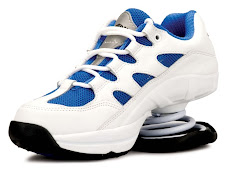
Check out the Z-CoiL Freedom athletic shoe, which may prevent pain in your shins when running. Because the conical coil acts as a shock-absorber, you will be placing less pressure on your joints with each stride.

Click here to read the full article.

Friday, September 18, 2009

Do You Spend Long Hours Working on Your Feet?

How Are Feet Affected?
The foot has dozens of bones, joints, muscles, nerves, blood vessels, tendons and layers of fascia (connective tissue). When the body tissues are sufficiently stressed, they become swollen and/or inflamed. Chronic inflammation may create scar tissue and changes to bony structures. The "it is" behind the words such as "Achilles tendonitis" means "inflammation of the Achilles tendon".
The bones of the foot form arches that are supported by ligaments and muscles. These arches contribute to the strength, stability, mobility, and resilience of the foot. During standing, walking, running or jumping, the arches serve as shock absorbers, spreading energy before it is transferred higher up the leg.


If the arches are lost (for example through conditions of flat foot, overpronation, or simple overuse), the shock-absorbing quality of the arches disappears. This affects the feet, knees, hips and spine. Losing the arch in your feet also changes the position of the knee and hip, which makes them more vulnerable to injury from working on your feet.

Besides the stress of prolonged standing and walking on the foot, the architecture of the foot can also increase the symptoms from pre-existing conditions:

  • Plantar fasciitis refers to the inflammation of the fascia under the heel. Flat or tilted feet (from heel pronation) and bony spurs in the base of the ankle may make the condition worse.

  • Achilles tendonitis results from overstretching of the Achilles tendon.

  • Bunions at the side of the big toe may arise because of heel pronation and may be aggravated by narrow shoe boxes (the area in front of the shoe) and prolonged standing/walking.

  • Corns on top of the toes may be aggravated by scraping against the inside of your shoe.

What Are Possible Health Symptoms From Working On Your Feet?
The most common symptom from working on your feet, and usually the first to occur, is discomfort and fatigue in the legs.

The closer the body part is to the ground, the more likely it will be affected by prolonged standing (i.e. the feet are most often affected, followed by the shins and calves, followed by the knees, thighs, hips and low back). However, symptoms from working on your feet may reach to the top of your body. In some studies neck symptoms have been related to prolonged standing work!

Beyond simple fatigue and discomfort, more serious health effects can result from working on your feet. In lab experiments people could not distinguish fatigue in their legs from whole-body fatigue. Therefore, that whole-body fatigue feeling could be related to working on your feet.
Some of these are:

  • Low Back Pain (Drewczynski, Hansen, et al., Redfern & Chaffin)

  • Painful feet and other foot problems (Drewczynski, Hansen, et al., Redfern & Chaffin)

  • Plantar Fasciitis and Heel Spurs (Cailliet)

  • Orthopedic changes in the feet (e.g. flat feet) (Redfern & Chaffin)

  • Restricted blood flow (from standing only) (Hansen, et al.)

  • Swelling in the feet and legs (Drewczynski, Hansen, et al.)

  • Varicose veins (Drewczynski)

  • Increased chance of arthritis in the knees and hips (Croft, et al.)

Initial symptoms can start within minutes into a standing task. Health effects have been shown to accumulate within days (no studies have assessed longer time periods).

Click Here to read the full article

Wednesday, August 19, 2009

How Z-CoiL Footwear Can Ease Your Back Pain

According to the American Chiropractic Association, 80% of the population will experience a back problem at some point in their lives, and half of all working Americans admit to having back pain symptoms each year. The back is a complicated structure of bones, joints, ligaments, and muscles. You can sprain ligaments, strain muscles, rupture disks, and irritate joints, all of which can lead to back pain. In addition, arthritis, poor posture, obesity, and psychological stress can cause or complicate back pain. Back pain can also directly result from disease of the internal organs, such as kidney stones, kidney infections, blood clots, or bone loss.

How Z-CoiL® footwear can help:
The shock-absorbing heel in Z-CoiL® footwear, in conjunction with thick forefoot cushioning, reduces impact to the body by up to 50% compared to conventional shoes. The built-in Z-Orthotic™ also promotes good posture, which relieves further stress on your back, while rocker-bottom soles in the shoes help you maintain a smooth gait as you walk.


Test out a pair of Z-CoiL shoes for yourself and feel the difference! Z-CoiL Store Locator