Thursday, November 12, 2009

Enjoy Z-CoiL's Picks of the Season at a Special Price!

No matter what, we have a shoe to match your style!
And for a limited time, you can get our Picks of the Season at a special price!
Click here for the printable certificate.
To find a Z-CoiL store in your area, visit our Store Locator.

Wednesday, November 4, 2009

Shin Splints? 10 Tips for Staying Pain-Free

I ran across a great article on active.com by Marlene Cimons and had to share some of the great tips with you. Click here to read the full article.

Shin splints is a general term used to refer to a painful condition in the shins. It is often caused by running or jumping or sprinting, and may be very slow to heal.

Experts agree that when shin splints strike, you should stop running completely or decrease your training. Then ice your shin to reduce inflammation. Here’s a sampling of the tips Marlene suggests:


  • Gently stretch your Achilles if you have medial shin splints, and your calves if you have anterior shin splints. Also, try this stretch for your shins: Kneel on a carpeted floor, legs and feet together and toes pointed directly back. Then slowly sit back onto your calves and heels, pushing your ankles into the floor until you feel tension in the muscles of your shin. Hold for 10 to 12 seconds, relax and repeat.

  • In a sitting position, trace the alphabet on the floor with your toes. Do this with each leg. Or alternate walking on your heels for 30 seconds with 30 seconds of regular walking. Repeat four times. These exercises are good for both recovery and prevention. Try to do them three times a day.

  • If you continue running, wrap your leg before you go out. Use either tape or an Ace bandage, starting just above the ankle and continuing to just below the knee. Keep wrapping your leg until the pain goes away, which usually takes three to six weeks.

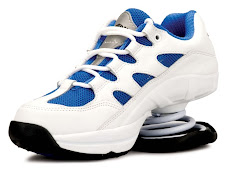
Check out the Z-CoiL Freedom athletic shoe, which may prevent pain in your shins when running. Because the conical coil acts as a shock-absorber, you will be placing less pressure on your joints with each stride.

Click here to read the full article.

Friday, October 23, 2009

Z-CoiL's "Best Idea On TWO Feet" Video Contest

The "Best Idea on Two Feet"
Z-CoiL footwear commercial contest

3 Winners, over $5,500 in cash & prizes AND the ability to have your commercial aired across the country!

Create a unique and original commercial for Z-CoiL Footwear and you could WIN BIG!

Make us laugh. Make us cry. Make us stand up and cheer! Make it something you’d want to see on TV.
Maybe it’s about your pain management, or how you can walk again because of Z-CoiL shoes; maybe it’s about your individuality, or a way to stand out; maybe it’s your way of staying on your feet longer and working harder than your co-workers; or maybe it’s your zany obsession with all things coiled.

Whatever it is; you write it. You cast it. You direct and shoot it. You have total creative control!
For official rules and to learn more visit the contest website at http://www.ztvcontest.com.

Thursday, October 1, 2009

My feet frequenly swell. Why and how do I minimize it?

Question: My feet frequenly swell. Why does this happen and how can I minimize it?

Answer: Your feet and ankles swell when fluid in the blood escapes from capillaries and accumulates in tissues, a condition known as peripheral edema. Causes range from benign to serious and include being overweight, long periods of standing, lengthy car or airplane rides, warm weather, and menstrual periods.

Most remedies work by improving circulation and returning fluid to blood vessels. Get regular exercise (contracting leg muscles helps the veins pump blood back to the heart), and lose weight if you need to. When sitting or standing in one position for a long time, stretch your legs and move around every couple of hours. Support hose, which you can buy at drugstores, also promote good circulation, and consider cutting your salt intake to a teaspoon or less daily, which helps reduce water retention.

In none of these remedies seems to help, a medical issue such as heart failure, kidney failure or side effects of prescription medications may be to blame. Work with your doctor to rule out these more serious causes.


For more information on swollen feet, click here.

Wednesday, September 30, 2009

Pop Quiz: Which Food Boosts Your Bones?

Question: Which food boosts your bones?

A) Nuts
B) Milk
C) Onions
D)Whole Wheat Bread


Answer: ALL OF THEM!

Foods such as milk that contain calcium and vitamin D aren’t the only ones that strengthen your skeleton. New research shows that two other compounds, inulin (found in onions and wheat, as well as in asparagus, artichokes, and bananas) and phytate (in nuts and whole grains), are also key. Inulin boosts calcium absorption, and phytate prevents bone mineral destruction. Spanish researchers found that people who ate phytate less than 3 times a week had the lowest bone mineral densities, a risk factor for osteoporosis.

Bottom line: A diverse diet with lots of veggies and whole grains is crucial for healthy bones too.

Prevention.com

Monday, September 21, 2009

Feet Get Older Too

I stumbled upon this really great article about foot pain and aging. I thought I would share it with you.
To read the full article, click here.


I NEVER THOUGHT about my feet until they started to hurt. And since then, they haven't let me forget them.

Among the physical changes associated with aging, such as wrinkly skin, sagging chins, graying hair and body fat that seems to drift south no matter what we do, nuances in the foot department get short shrift.

Feet are just, well, feet. We don't see them when we look in the mirror. And unless we're wearing sandals, hardly anybody else sees them either.

But on one of those important milestone birthdays, my feet decided to let me know they wanted some respect.

Without warning, while on a beautiful walk during a celebratory trip, those two stalwart, reliable drudges of transportation began to radiate something new: pain. Decades of carrying me over hard pavement, dirt trails or burning sand, of being encased in nonbreathable nylons or strangled in high-heeled or narrow designs had taken a toll.

"Hey," was the message. "Pay attention."


After years of ignoring their contributions, the least I can do now is be kind to my feet. I hope to be working with them for a long while.


...

Tips for aging feet:
Besides bunions and hammertoes, other common problems for aging feet are: fungus infections, prevented by keeping the feet clean and dry; bone spurs, or calcium deposits worsened by standing on the feet for long periods; dry skin, helped by daily application of lotion to the feet; corns, calluses and ingrown toenails.


Tips on buying shoes:
When you buy shoes, follow these tips from the National Association on Aging. Have feet measured; buy shoes at the end of the day, when feet are largest; fit your shoe to your larger foot; make sure there is enough space — up to half an inch — for your longest toe at the end of each shoe when you are standing up; make sure the ball of your foot fits comfortably into the widest part of the shoe; don't buy shoes that feel too tight and expect them to stretch to fit; make sure the heel fits comfortably in the shoe with a minimum amount of slipping — shoes should not ride up and down on your heel when you walk.


Z-CoiL shoes are solidly constructed, conform to your feet and have cushioned soles that absorb the shock of hard surfaces.

Try a lace-up style, such as the Freedom or High Desert Hiker. A shoe that ties can be adjusted for better comfort and support.

Friday, September 18, 2009

Do You Spend Long Hours Working on Your Feet?

How Are Feet Affected?
The foot has dozens of bones, joints, muscles, nerves, blood vessels, tendons and layers of fascia (connective tissue). When the body tissues are sufficiently stressed, they become swollen and/or inflamed. Chronic inflammation may create scar tissue and changes to bony structures. The "it is" behind the words such as "Achilles tendonitis" means "inflammation of the Achilles tendon".
The bones of the foot form arches that are supported by ligaments and muscles. These arches contribute to the strength, stability, mobility, and resilience of the foot. During standing, walking, running or jumping, the arches serve as shock absorbers, spreading energy before it is transferred higher up the leg.


If the arches are lost (for example through conditions of flat foot, overpronation, or simple overuse), the shock-absorbing quality of the arches disappears. This affects the feet, knees, hips and spine. Losing the arch in your feet also changes the position of the knee and hip, which makes them more vulnerable to injury from working on your feet.

Besides the stress of prolonged standing and walking on the foot, the architecture of the foot can also increase the symptoms from pre-existing conditions:

  • Plantar fasciitis refers to the inflammation of the fascia under the heel. Flat or tilted feet (from heel pronation) and bony spurs in the base of the ankle may make the condition worse.

  • Achilles tendonitis results from overstretching of the Achilles tendon.

  • Bunions at the side of the big toe may arise because of heel pronation and may be aggravated by narrow shoe boxes (the area in front of the shoe) and prolonged standing/walking.

  • Corns on top of the toes may be aggravated by scraping against the inside of your shoe.

What Are Possible Health Symptoms From Working On Your Feet?
The most common symptom from working on your feet, and usually the first to occur, is discomfort and fatigue in the legs.

The closer the body part is to the ground, the more likely it will be affected by prolonged standing (i.e. the feet are most often affected, followed by the shins and calves, followed by the knees, thighs, hips and low back). However, symptoms from working on your feet may reach to the top of your body. In some studies neck symptoms have been related to prolonged standing work!

Beyond simple fatigue and discomfort, more serious health effects can result from working on your feet. In lab experiments people could not distinguish fatigue in their legs from whole-body fatigue. Therefore, that whole-body fatigue feeling could be related to working on your feet.
Some of these are:

  • Low Back Pain (Drewczynski, Hansen, et al., Redfern & Chaffin)

  • Painful feet and other foot problems (Drewczynski, Hansen, et al., Redfern & Chaffin)

  • Plantar Fasciitis and Heel Spurs (Cailliet)

  • Orthopedic changes in the feet (e.g. flat feet) (Redfern & Chaffin)

  • Restricted blood flow (from standing only) (Hansen, et al.)

  • Swelling in the feet and legs (Drewczynski, Hansen, et al.)

  • Varicose veins (Drewczynski)

  • Increased chance of arthritis in the knees and hips (Croft, et al.)

Initial symptoms can start within minutes into a standing task. Health effects have been shown to accumulate within days (no studies have assessed longer time periods).

Click Here to read the full article